

Portuguese food is much broader than custard tarts and cod. Travel from Porto to the Algarve, or out to Madeira, and the dishes change with the landscape, local ingredients and regional traditions.
If this is your first trip to Portugal, the 12 foods below are a practical place to start. They include everyday café food, seafood, hearty regional dishes and one sweet that is almost impossible to avoid.
Portuguese food at a glance
| Food | What to expect | Especially associated with |
|---|---|---|
| Pastel de nata | Flaky custard tart | Across Portugal |
| Bacalhau à Brás | Salt cod, potato and egg | Across Portugal |
| Caldo verde | Potato and greens soup | Northern Portugal |
| Sardinhas assadas | Charcoal-grilled sardines | Lisbon and coastal Portugal |
| Bifana | Pork sandwich | Across Portugal |
| Cozido à portuguesa | Meat, sausages and vegetables | Across Portugal |
| Francesinha | Meat sandwich with cheese and sauce | Porto |
| Alheira | Traditional sausage | Trás-os-Montes |
| Leitão da Bairrada | Roast suckling pig | Bairrada |
| Cataplana | Seafood or fish cooked in a lidded pan | Algarve |
| Arroz de marisco | Brothy shellfish rice | Coastal Portugal |
| Espetada | Beef skewered and grilled | Madeira |
1. Pastel de nata

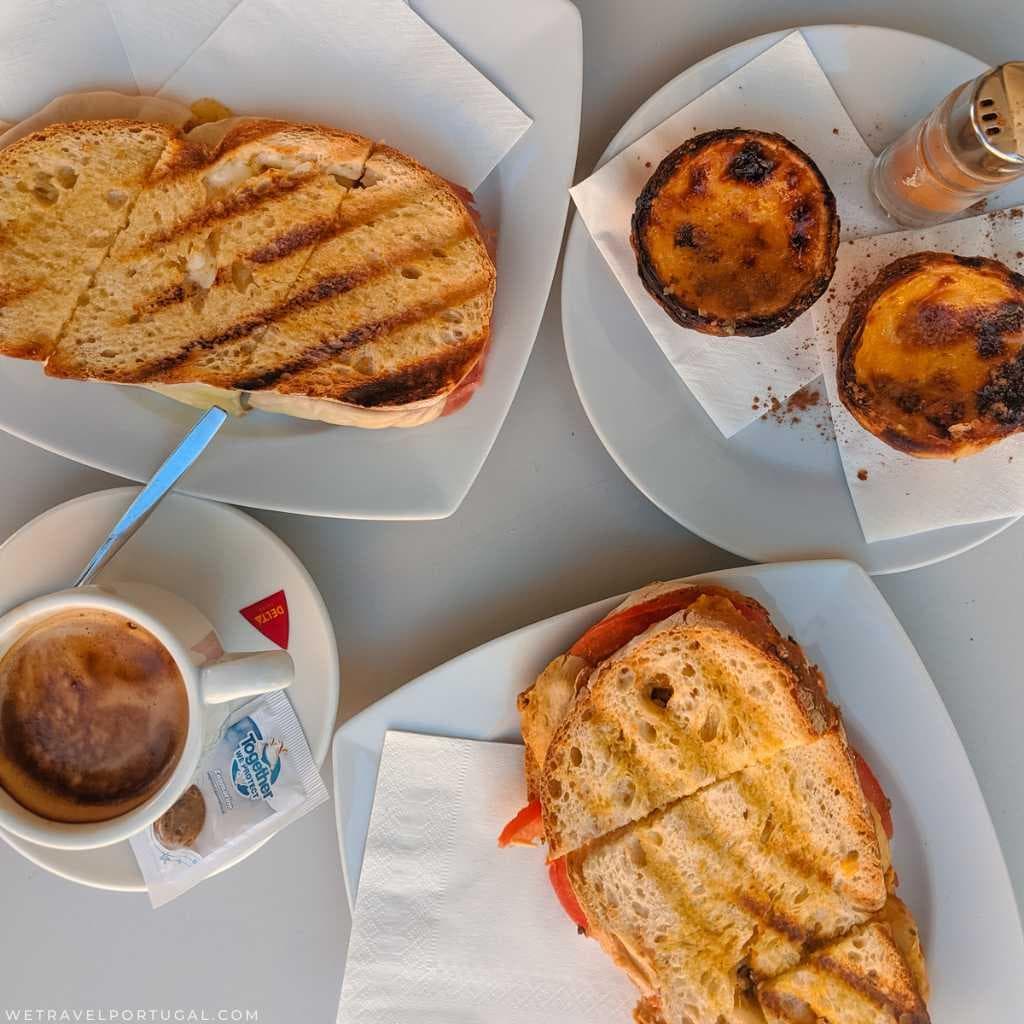
For many travellers, the pastel de nata is the easiest introduction to Portuguese food: crisp layers of pastry surrounding a creamy egg custard, usually with a browned surface.
It is not just a Lisbon speciality. Pastéis de nata are sold in pastry shops and cafés throughout Portugal, and Turismo de Portugal describes them as the country's most iconic sweet treat, commonly enjoyed with espresso.
If you are in Lisbon, you will also encounter Pastéis de Belém. That famous Belém version deserves its own story; for this broader guide, the important distinction is simply that pastel de nata is the general pastry found across Portugal.
Try it if: you want one Portuguese food that requires virtually no planning.
2. Bacalhau à Brás

Salt cod bacalhau appears in Portuguese cooking in many forms, but Bacalhau à Brás is one of the easiest versions for a first-time visitor to approach.
The dish combines shredded cod with thin fried potatoes and eggs, producing a soft, savoury mixture rather than a large piece of fish. Turismo de Portugal lists Bacalhau à Brás among the country's popular cod preparations
It is worth remembering that “Portuguese cod” does not mean the fish was caught off Portugal. The cod traditionally used in these dishes comes from North Atlantic fisheries and became deeply embedded in Portuguese cuisine.
Try it if: you want to understand why bacalhau plays such a large role in Portuguese cooking without beginning with one of its heavier preparations.
3. Caldo verde

Caldo verde is one of Portugal's best-known soups. Its base typically includes potato, onion, garlic and olive oil, with finely cut couve-galega and often slices of chouriço.
It is particularly associated with northern Portugal but appears well beyond the North.
You may also see it during traditional celebrations. Turismo de Portugal specifically highlights caldo verde alongside grilled sardines during the Popular Saints festivities in older neighbourhoods of Lisbon and Porto.
Try it if: you want something simple, inexpensive and deeply rooted in Portuguese home-style cooking.
4. Sardinhas assadas

Few foods are as closely tied to Portuguese summer celebrations as sardinhas assadas whole sardines grilled over charcoal.
During the Popular Saints season, particularly in Lisbon and Porto, grilled sardines are traditionally eaten on bread and often accompanied by caldo verde.
Sardines are not limited to festivals, but season matters. A smoky plate of grilled sardines makes much more sense as a warm-weather coastal meal than as something you need to hunt down in every month of the year.
Try it if: you are visiting in summer, particularly around June.
5. Bifana

A bifana is one of the least complicated foods on this list: a Portuguese pork sandwich.
That simplicity is the point.
Turismo de Portugal includes the bifana among the country's traditional sandwiches and highlights cafés and tascas as some of the places where visitors can experience Portuguese everyday food.
Recipes and seasonings vary, so two bifanas can taste noticeably different even though both begin with pork and bread.
This is not necessarily the meal to reserve a formal restaurant for. It belongs naturally in the café, snack-bar and casual-food side of Portugal.
Try it if: you want a quick lunch or snack between sightseeing stops.
6. Cozido à portuguesa

If the bifana represents Portuguese food at its simplest, cozido à portuguesa sits at the opposite end of the spectrum.
It is a substantial combination of meats, Portuguese sausages and vegetables cooked together. Turismo de Portugal identifies it as one of the country's principal traditional meat dishes.
The exact contents can vary, which is part of the dish rather than a flaw in standardisation. Cozido is more useful to understand as a family of hearty boiled-meat meals than as one rigid recipe.
Come hungry.
Try it if: you want a substantial traditional lunch rather than a light meal.
7. Francesinha

The francesinha belongs to Porto.
At its core, it is a stacked meat sandwich covered with melted cheese and a hot sauce. Turismo de Portugal describes versions containing cured ham, sausage and steak, finished with a tomato-and-beer-based sauce.
It is rich, messy and intentionally excessive. This is one of those Portuguese dishes for which geography matters: you can find francesinhas elsewhere, but Porto is the place most strongly associated with it. The city's official tourism material also treats the francesinha as one of Porto's iconic dishes.
Try it if: Porto is on your itinerary and you want one unmistakably local meal.
8. Alheira

The alheira takes you into the food traditions of northern and northeastern Portugal, particularly Trás-os-Montes.
It is a seasoned sausage with numerous regional and modern variations. Turismo de Portugal specifically highlights the alheira of Mirandela and Miranda do Douro when describing the cuisine of Porto and northern Portugal.
It is therefore a useful reminder that Portuguese gastronomy is not simply seafood plus pastries. Inland regions have their own strong traditions built around meat, smoked products and sausages.
Try it if: you are travelling through northern Portugal or want to explore the country's enchidos beyond chouriço.
9. Leitão da Bairrada

Travel through central Portugal and leitão assado da Bairrada becomes difficult to ignore.
This is roast suckling pig associated particularly with Bairrada. Turismo de Portugal notes that the dish attracts diners from around the country to the region's restaurants.
The appeal is the contrast: crisp skin outside and tender meat beneath it.
Bairrada lies between some of the country's most common Lisbon–Porto travel stops, so this is also a dish worth considering if your Portugal itinerary extends beyond the two largest cities.
Try it if: you are travelling through central Portugal and want a regional meal worth planning around.
10. Cataplana

A cataplana is both a cooking vessel and the name commonly attached to the dishes prepared inside it.
It is particularly associated with the Algarve. The traditional hinged vessel closes around the ingredients while fish, shellfish, vegetables, herbs and other ingredients cook together. Turismo de Portugal highlights cataplana dishes as a defining element of Algarve cuisine.
That also means there is no single cataplana recipe you must order. You may encounter fish cataplana, clam-based versions or other seafood combinations.
Try it if: you are travelling through the Algarve and want a dish strongly connected with southern Portugal.
11. Arroz de marisco

Do not expect arroz de marisco to resemble a dry rice dish.
Portuguese shellfish rice is generally served moist and brothy, allowing the rice to absorb the flavour of the seafood and cooking liquid.
Along Portugal's coast, seafood rice belongs naturally to fishing communities; Turismo de Portugal specifically identifies arroz de marisco among the local gastronomic specialities of Vieira de Leiria.
Because seafood varies by place and availability, the exact contents of the pot can change.
Try it if: seafood is one of the main reasons you are looking forward to eating in Portugal.
12. Espetada madeirense

Mainland Portugal does not tell the whole Portuguese food story.
In Madeira, one of the defining traditional dishes is espetada, most classically beef cooked on skewers. Turismo de Portugal describes the traditional Madeiran version as marinated beef grilled on laurel-stick skewers and commonly accompanied by fried corn.
Madeira's official tourism organisation also places espetada regional among the archipelago's central traditional foods.
If you are visiting Madeira, pair this list with a deeper look at the island's food: bolo do caco, limpets, black scabbardfish dishes and other regional specialities easily justify a guide of their own.
Try it if: Madeira is part of your Portugal itinerary.
If you can only try five
For a first trip, prioritise pastel de nata, Bacalhau à Brás, caldo verde, a regional seafood dish and whichever major regional speciality matches your itinerary.
In Porto, make that francesinha. In the Algarve, choose cataplana. In Bairrada, leitão. In Madeira, espetada.
That approach is more useful than trying to find the same “top Portuguese dishes” everywhere you go: one of the strengths of Portuguese food is that travelling through the country changes what belongs on the table.


Comments
Sign in to join the discussion. Sign in